
Every ingredient.
Every dose. Every reason.
Every active, every dose, and the research behind each one. Nothing summarized, nothing withheld.
Why one ingredient is never enough
Single-ingredient supplements target one problem. The brain is a system of interconnected pathways. Novium-9 covers five of them deliberately, with ingredients whose mechanisms overlap (so no single function carries the load alone).
| Ingredient per 2 caps | Memory & recall |
Focus & clarity |
Calm & mood |
Energy & antioxidant |
Neural foundation |
|---|---|---|---|---|---|
| Bacopa Monnieri300 mg · 50% bacosides | |||||
| Citicoline250 mg | |||||
| Huperzine A60 mcg | |||||
| Phosphatidylserine100 mg · sunflower | |||||
| Ginkgo Biloba120 mg · 24% glyc. | |||||
| Ashwagandha300 mg · 5% withan. | |||||
| Saffron30 mg · 0.3% safranal | |||||
| PQQ20 mg | |||||
| Vitamin B62 mg · P-5-P | |||||
| Methylfolate400 mcg · L-5-MTHF | |||||
| Methylcobalamin100 mcg · B12 |
Every pathway is reached by at least three ingredients. No ingredient carries a pathway alone. Attributions reflect the dominant clinical evidence for each ingredient at the dose used in Novium-9 (sources 1–9).

Every dot on that chart is a moment in someone's day.
A name that arrives on time. An afternoon that stays clear. A meeting where you're the one who remembers the number. The science only matters if it shows up in your day.
Our ingredients, explained
Tap any ingredient for how it works, what you'll notice, the research behind it, and how our dose compares to what's typical.
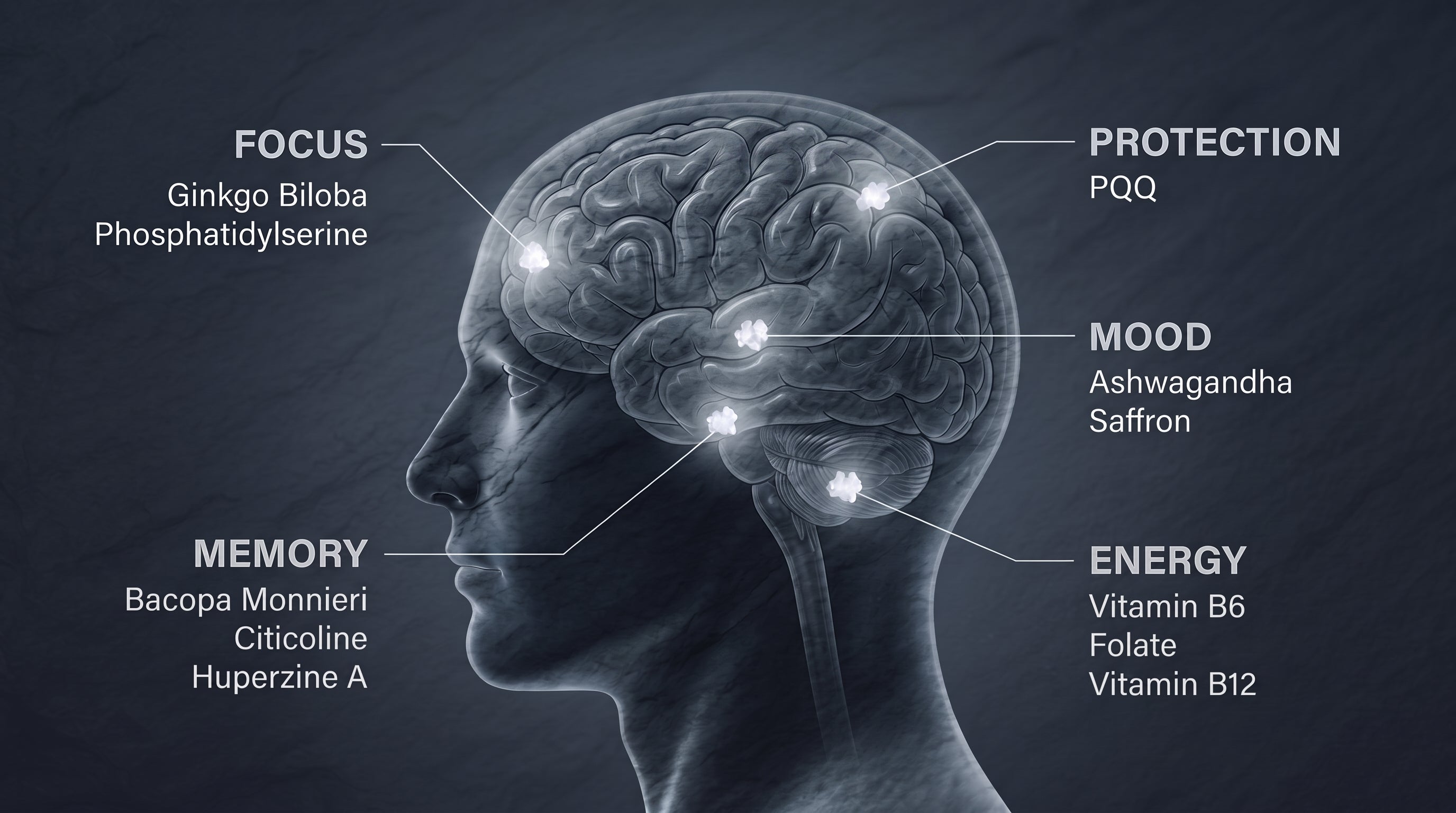
 Bacopa Monnieri
 Citicoline
 Huperzine A
 Ginkgo Biloba
 Phosphatidylserine
 Ashwagandha
 Saffron
 PQQ
PQQ
 Vitamin B6
 Vitamin B12
 Folate
 Bacopa Monnieri 300 mg · 50% bacosides
How it works
Bacopa strengthens dendrites, the signal receivers on your neurons. Think of it as improving the antenna that captures cognitive signals. Over time this leads to clearer thinking and better memory formation.
What you'll notice
Clearer recall of names, faces, and details; a sense of mental sharpness that builds through weeks 6 to 8; better retention when learning.
The research
A 12-week randomized controlled trial showed significant improvements in memory, processing speed, and attention. Bacosides upregulate proteins critical for learning.
Our dose vs. typical
300 mg at 50% bacosides. Competitors typically use 100–150 mg with lower standardization, which puts them below clinically meaningful thresholds.
 Citicoline 250 mg
How it works
A two-for-one: it supplies choline your body uses to support healthy acetylcholine levels, and it provides building blocks for the neuronal membranes behind clear signaling.
What you'll notice
Improved attention span, better focus on complex tasks, faster processing; some report clearer articulation of thoughts.
The research
A 12-week trial at 250 mg showed significant improvements in attention, processing speed, and recall. Benefits confirmed across 250–500 mg.
Our dose vs. typical
250 mg, squarely in the clinical range of 250 to 500 mg. Efficacy without unnecessary excess.
 Huperzine A 60 mcg
How it works
A botanical with a long history of traditional use for memory and focus. It complements citicoline to round out cognitive support.
What you'll notice
Sustained focus over long sessions, better retention of what you read, the "stickiness" of new information.
The research
Huperzine A has been studied for decades for its role in supporting memory and attention.
Our dose vs. typical
60 mcg within the established clinical range of 50 to 200 mcg. Effective without over-suppressing breakdown.
 Phosphatidylserine 100 mg · from sunflower
How it works
A key building block of neuronal membranes. It maintains the structural integrity and fluidity essential for efficient neurotransmission.
What you'll notice
Smoother transitions between tasks, reduced mental fog, a sense of clarity from neurons working optimally.
The research
Meta-analyses of RCTs show significant improvements in memory, attention, and mood stability with consistent use.
Our dose vs. typical
100 mg from non-GMO sunflower. Research supports 100–300 mg; we use the lower end to integrate cleanly with the rest of the formula.
 Ginkgo Biloba 120 mg · 24% glycosides
How it works
Increases cerebral blood flow, delivering more oxygen and nutrients to the cognitive centers, especially the prefrontal cortex where focus and decisions happen.
What you'll notice
Better sustained focus (especially the afternoon), less mental fatigue, sharper concentration on complex tasks.
The research
Multiple RCTs confirm ginkgo's effect on cerebral blood flow and cognition. It's one of the most extensively studied nootropics there is.
Our dose vs. typical
120 mg at 24% glycosides. Research supports 120–240 mg; we start at the proven effective dose.
 Ashwagandha 300 mg · 5% withanolides
How it works
Modulates cortisol. When cortisol is high, cognition drops; ashwagandha helps normalize it so the brain operates from calm clarity rather than stress.
What you'll notice
Reduced anxiety under pressure, better resilience under deadline stress, calm focus without jitters, improved sleep quality.
The research
Ashwagandha root extract at this standardization is studied extensively, with reduced cortisol and anxiety with improved cognition and mood stability.
Our dose vs. typical
300 mg at 5% withanolides. Competitors often use 150–250 mg with lower standardization, below effective thresholds for cortisol modulation.
 Saffron Extract 30 mg · 0.3% safranal
How it works
Supports serotonin production and reuptake. Balanced serotonin stabilizes mood, increases motivation, and builds resilience to stress.
What you'll notice
Improved mood and motivation, emotional stability, the ability to keep focus through setbacks.
The research
Multiple clinical trials have studied saffron at 30 mg daily for mood and cognitive support.
Our dose vs. typical
30 mg at 0.3% safranal. Most competitors omit saffron entirely because it's expensive. The research is too strong to leave out.
 PQQ 20 mg · pyrroloquinoline quinone
How it works
Stimulates mitochondrial biogenesis, the creation of new mitochondria, your cells' energy powerhouses. More mitochondria, more ATP for every cognitive task.
What you'll notice
Sustained mental energy through the day, fewer afternoon crashes, focus without fatigue on long sessions.
The research
Studies at 10–20 mg show PQQ enhances cognitive function and supports memory. It's a newer ingredient, and the evidence is growing fast.
Our dose vs. typical
20 mg, the upper end of studied doses. Maximum mitochondrial support without excess.
 Vitamin B6 2 mg · P-5-P (active)
What it does
A cofactor for neurotransmitter synthesis. Without enough B6, the brain can't efficiently produce serotonin, dopamine, GABA, or glutamate.
Why this form
We use P-5-P, the active form, so your body skips the conversion step from pyridoxine HCl. That matters if you carry variants affecting B6 metabolism.
Dose vs. RDA
2 mg = 118% of the RDA, in the bioavailable form. Robust neurotransmitter support, not just deficiency prevention.
 Folate 400 mcg · L-5-MTHF (active)
What it does
Drives methylation, which is critical for DNA repair, neurotransmitter synthesis, and myelin formation. Essential to the methylation cycle the brain runs on.
Why this form
We use L-5-MTHF, not synthetic folic acid. 30 to 50% of people carry MTHFR variants that impair conversion; the active form bypasses that entirely.
Dose vs. RDA
400 mcg = 100% of the RDA, in the bioavailable form. Optimal methylation support without excess.
 Vitamin B12 100 mcg · methylcobalamin (active)
What it does
Essential for myelin, the insulating sheath that allows fast, clean signal transmission. B12 is one of the nutrients the brain is least willing to run short on.
Why this form
We use methylcobalamin (active), not synthetic cyanocobalamin, so it's immediately available for methylation and myelin support.
Dose vs. RDA
100 mcg = 4,167% of the RDA. Seems high, but B12 has virtually no toxicity (excess is excreted) and this ensures robust myelin support.
A note on our label. Three ingredients (Ginkgo Biloba at 120 mg, Phosphatidylserine at 100 mg, and PQQ at 20 mg) sit together on the bottle under the heading "Foundational Support Blend," which totals 240 mg. Every one of those amounts is printed individually, on the bottle and here. Grouping a heading is not the same as hiding a dose, and we don't hide doses.
Not all B-vitamins are created equal
Most supplements use cheap synthetic B-vitamins your body must convert into the active forms the brain uses. For the 30–50% of people with common MTHFR variants, that conversion runs slowly or incompletely. We skip the bottleneck entirely.
Most brands: synthetic forms
The bottleneck: 30–50% carry MTHFR or related polymorphisms that reduce conversion, which means the active form may never reach the brain at full dose.
Novium-9: active forms
Active forms bypass conversion. What's on the label is what reaches the brain, whatever your MTHFR genotype.
MTHFR variant prevalence: Frosst et al., Nature Genetics, 1995, plus subsequent literature (source 10).
What's not in the formula
Three ingredients almost every cognitive formula reaches for. None of them earned the slot, judged on the same criteria as everything that did.
Caffeine
L-Theanine
Lion's Mane

Enough to work. Never more than is safe.
Two capsules clears every clinical minimum. Four stays inside every safe ceiling. Every ingredient, drawn to scale.
Built for two. Designed to double.
Two capsules is the daily serving, and it clears the clinical-effective minimum on every ingredient in the formula. Four is there for the stretches when you want the full research dose of everything at once, and at four, every ingredient still sits inside its safe upper bound.
Most formulas can't do this. They're dosed so low that doubling only gets you to adequate, or so high that doubling takes you past safe. We built the headroom in on purpose.
Drawn to scale per ingredient. The shaded band spans each ingredient's clinical-effective minimum to its safe upper bound; the navy dot is the daily 2-capsule dose, the red ring the doubled 4-capsule dose. Minimums and bounds are from the clinical-trial literature and established tolerable-intake levels where defined (see Sources); citicoline is tolerated to ~2,000 mg, so a conservative ceiling is shown. Consult your provider if pregnant, nursing, or on medication.
Lab-tested every lot. COA published.
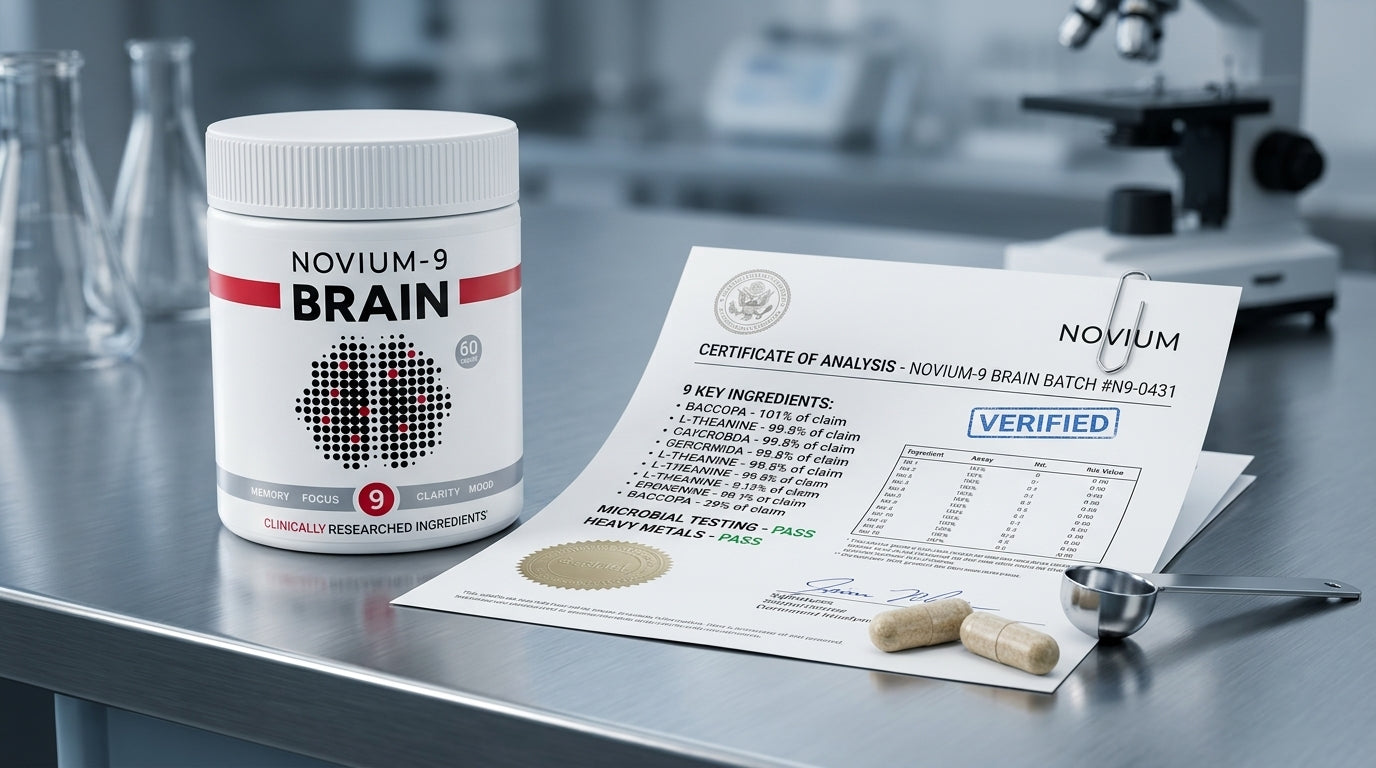
Every lot gets tested for label-claim accuracy, heavy metals, and microbiology. Then we publish the Certificate of Analysis, so you can read the actual numbers instead of taking our word for it.
Made in the USA, in a GMP-certified facility.
Sources
- Synoradzki, K., & Grieb, P. (2019). Citicoline: A Superior Form of Choline? Nutrients, 11(7), 1569.
- Stough, C., et al. (2008). Nootropic effects of Bacopa monniera on cognitive functioning: 90-day RCT. Phytotherapy Research, 22(12). Plus Roodenrys, S., et al. (2002). Neuropsychopharmacology, 27(2).
- Smith, A.D., & Refsum, H. (2016). Homocysteine, B Vitamins, and Cognitive Impairment. Annual Review of Nutrition, 36.
- Kennedy, D.O., et al. (2007). Cholinesterase-inhibiting sage and cognitive performance. Psychopharmacology, 191(1). (Cerebral blood-flow framework.)
- Salve, J., et al. (2019). Adaptogenic and anxiolytic effects of ashwagandha in healthy adults. Cureus, 11(12). Plus Cheah, K.L., et al. (2021). PLoS ONE, 16(9).
- Lopresti, A.L., et al. (2020). Saffron extract and sleep quality in adults. Journal of Clinical Sleep Medicine, 16(6).
- Kato-Kataoka, A., et al. (2010). Soybean-derived phosphatidylserine and memory in elderly subjects. J. Clinical Biochemistry & Nutrition, 47(3).
- Nakano, M., et al. (2012). Oral PQQ on stress, fatigue, and sleep. Functional Foods in Health and Disease, 2(8).
- Yang, G., et al. (2013). Huperzine A: a systematic review and meta-analysis of RCTs. PLoS ONE, 8(9).
- Frosst, P., et al. (1995). A common mutation in MTHFR. Nature Genetics, 10(1). Plus subsequent literature on variant prevalence.
Now you've seen the receipts.
Nine ingredients, every dose printed, every study cited. Read it all again if you want. Then take the 60 days.
Shop Novium-960-day money-back guarantee · free shipping · cancel anytime